The rights of parties to criminal proceedings: judges explored European approaches to safeguarding procedural guarantees
On 21–22 May 2026, the National School of Judges of Ukraine, in collaboration with the European Union Advisory Mission in Ukraine, held a training-of-trainers course on “The Rights of Parties to Criminal Proceedings: National Practice and European Union Standards”. During the event, a new practical guide entitled ‘Conducting Criminal Proceedings in Absentia’ was also presented to judges of local general and appeal courts. The main aim of the training was to enhance judges’ professional competence in ensuring the rights of all participants in criminal proceedings at various stages of the process. Participants consolidated their knowledge of constitutional, convention-based and European standards for the protection of the rights of suspects, accused persons, victims, witnesses, defence lawyers, interpreters, experts and other participants in the proceedings.
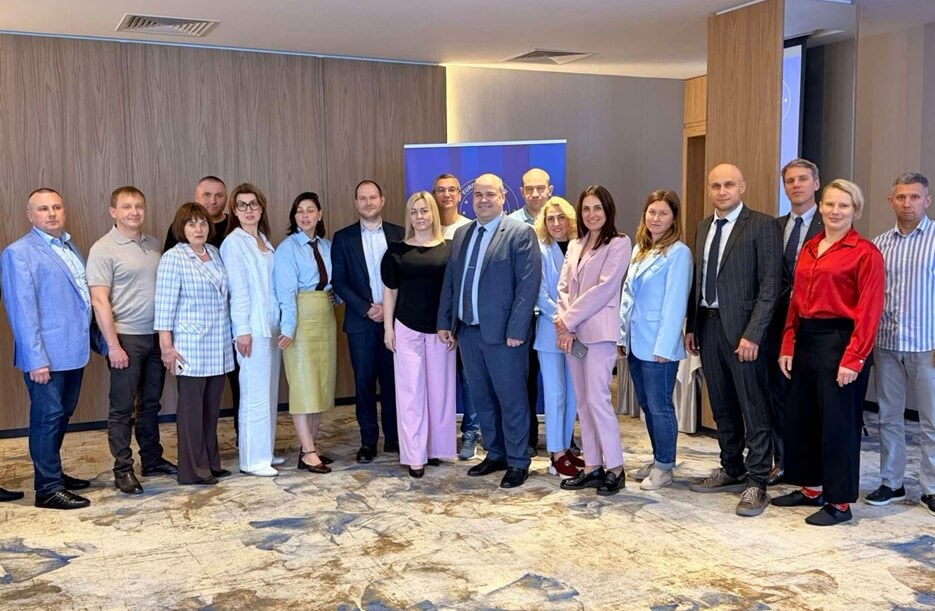
Particular attention was paid to practical approaches to responding to cases where procedural rights are restricted or infringed, as well as to the application of the case law of the Supreme Court, the European Court of Human Rights and the law of the European Union.
Opening the training, Yelyzaveta Kovtiuk, course director and lecturer-coordinator of the Trainer Training Department at the National School of Judges of Ukraine, emphasised the importance of continuously improving judges’ competencies in the field of human rights protection. The participants were also addressed by Mari-Ann Roos and Anu Valimaki, senior advisers on legal reform at the EU Advisory Mission in Ukraine – the latter being a judge at the Pajat-Hame District Court (Finland).
Leading Ukrainian judges and experts contributed to the training. Among them were Nataliia Akhtyrska, Head of the EU Law Training Laboratory at the National School of Judges of Ukraine; Mykola Mazur, a judge of the Supreme Court serving on the Criminal Cassation Court; and judges from local courts across various regions of Ukraine, who shared their practical experience of applying procedural safeguards in criminal proceedings.
A separate part of the event was the presentation of the handbook ‘Conducting Criminal Proceedings in Absentia’, which is intended to serve as a practical guide for judges when hearing cases in the absence of the accused. During the presentation, Christopher Russell, a rule of law specialist at the OSCE Office for Democratic Institutions and Human Rights, emphasised the particular relevance of this topic for the Ukrainian judicial system.
The authors of the handbook are Mykola Mazur, a judge of the Grand Chamber of the Supreme Court; Mykhailo Zimin, a judge of the Pokrovsk District Court in Kryvyi Rih; Vladyslav Ovsyannikov, a judge of the Derhachi District Court in Kharkiv Oblast; and Iryna Shapovalova, a judge of the Dnipro District Court in Dnipropetrovsk Oblast.
The organisation of such training events contributes to the implementation of European standards in national judicial practice, the strengthening of guarantees of a fair trial, and the development of uniform approaches to the protection of the rights of parties to criminal proceedings in Ukraine.
 Вища кваліфікаційна комісія суддів України
 Сайт Президента України
 Верховна Рада України
 Урядовий портал
 Судова влада України
 Вища рада правосуддя