The inevitability of punishment for war crimes: the National Security and Defence Council of Ukraine is stepping up cooperation with its European partners
Ukraine is aligning its judicial system with the provisions of the Rome Statute of the International Criminal Court. This requires Ukrainian judges to adopt entirely new approaches to drafting sentences for war criminals, to standardise terminology, and to develop a thorough understanding of international criminal law.
With this in mind, on 23 June 2026, the Acting Rector of the National School of Judges of Ukraine, Nataliia Shuklina, together with a team of specialists from the School, held a meeting with representatives of the new project ‘Trust Through Justice in Ukraine’. The meeting was attended by the project lead, David M. Vaughan, senior legal adviser Nataliia Petrova, legal adviser Uliana Pashynna and operations manager Iryna Hladka.
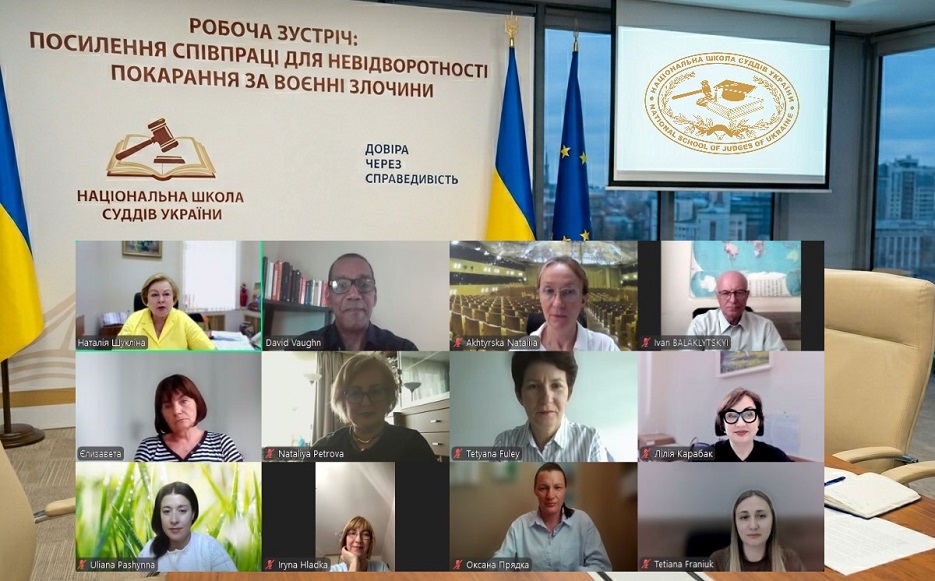
The project is funded by the Ministry of Foreign Affairs of the Netherlands and implemented by the European Union Advisory Mission in Ukraine in partnership with Chemonics UK. The initiative builds on the work begun under the USAID ‘Justice for All’ Programme, with which the National School of Judges of Ukraine has collaborated for many years.
During the meeting, the parties discussed key areas of cooperation within the new project. One of the main issues was the update of the Guide on Drafting Judicial Decisions in War Crimes Cases for Judges, developed in 2024 as part of the partnership between the National School of Judges of Ukraine and the ‘Justice for All’ Programme.
The need to update the publication stems from the transposition of the provisions of the Rome Statute of the International Criminal Court into Ukrainian national law, as well as amendments to criminal and criminal procedure legislation. The updated guide must take into account the new legislative provisions and current judicial practice.
It is envisaged that the sections on war crimes and forms of criminal liability – in particular, command responsibility – will be revised, and a new section on crimes against humanity will be drafted. In addition, experts will work on standardising terminology and improving the structure and style of the material.
Particular attention was paid to the development of training programmes for judges on the drafting of judicial decisions in cases involving war crimes, the organisation of training-of-trainers sessions, and the creation of training courses for judges and court staff on working with vulnerable victims and witnesses.
Following the meeting, the parties agreed to draw up a joint plan of priorities, which will set out the future directions for cooperation and the development of educational initiatives in the field of international criminal justice.
 Вища кваліфікаційна комісія суддів України
 Сайт Президента України
 Верховна Рада України
 Урядовий портал
 Судова влада України
 Вища рада правосуддя